Introduction
One of the biggest misconceptions in the watch market today is that all replica watches are easy to spot. In reality, high-end superclone watches have reached a level where even experienced collectors need to look twice—sometimes with tools—to identify differences from genuine pieces.
The truth is simple: a true 1:1 superclone is defined not by appearance alone, but by how closely it replicates the mechanical and structural behavior of the original watch. This includes movement architecture, finishing precision, and material integrity.
In this guide, we break down the five technical signs that separate a genuine watch from a top-tier Rolex Superclone—based on real-world inspection, factory standards, and how these watches perform under daily use.
Why “1:1” Is a Technical Standard, Not a Marketing Term
In the superclone watches market, “1:1” is often overused. However, among serious collectors and dealers, the term has a very specific meaning. It refers to a watch that replicates not just the visual design, but the underlying engineering principles of the original.
Factories such as VSF, Clean, ARF, APS, and 3K—based in China—have pushed this standard forward by focusing on movement replication, CNC machining precision, and material upgrades. These watches are distributed globally, with the USA representing one of the largest buyer markets.
For buyers across the USA, especially in cities like New York and Miami, the challenge isn’t finding a superclone—it’s identifying whether it truly meets the 1:1 benchmark. That requires understanding what’s happening beneath the dial, not just what’s visible on the surface.
What Defines a 1:1 Superclone Mechanically
The most important difference between a standard replica and a high-end superclone lies in movement architecture. A genuine Rolex movement is built around efficient energy transfer, stable amplitude, and long-term durability. Top-tier superclones aim to replicate this structure, not just mimic its layout.
Take the VS3235 caliber as an example. This movement uses a fully integrated gear train designed to minimize friction and optimize torque distribution. The result is stable amplitude—meaning the balance wheel maintains consistent oscillation regardless of wrist movement patterns.
The escapement system regulates energy release in controlled intervals. In high-end builds, the geometry of this system closely mirrors genuine specifications, leading to smoother second-hand motion and improved timekeeping accuracy.
Rotor winding efficiency is equally critical. A well-designed rotor converts wrist motion into stored energy with minimal resistance. In practical terms, this means the watch maintains its power reserve more effectively, reducing the need for manual winding.
Chronograph models introduce additional complexity. The DD4130 movement replicates Rolex’s column wheel and vertical clutch system, allowing for precise chronograph engagement without the “jump” or lag seen in lower-tier movements.
Material selection also matters. High-end superclone watches use 904L stainless steel, which offers superior corrosion resistance and a more refined polish compared to 316L. Combined with CNC machining, this ensures accurate case geometry and consistent finishing across production batches.
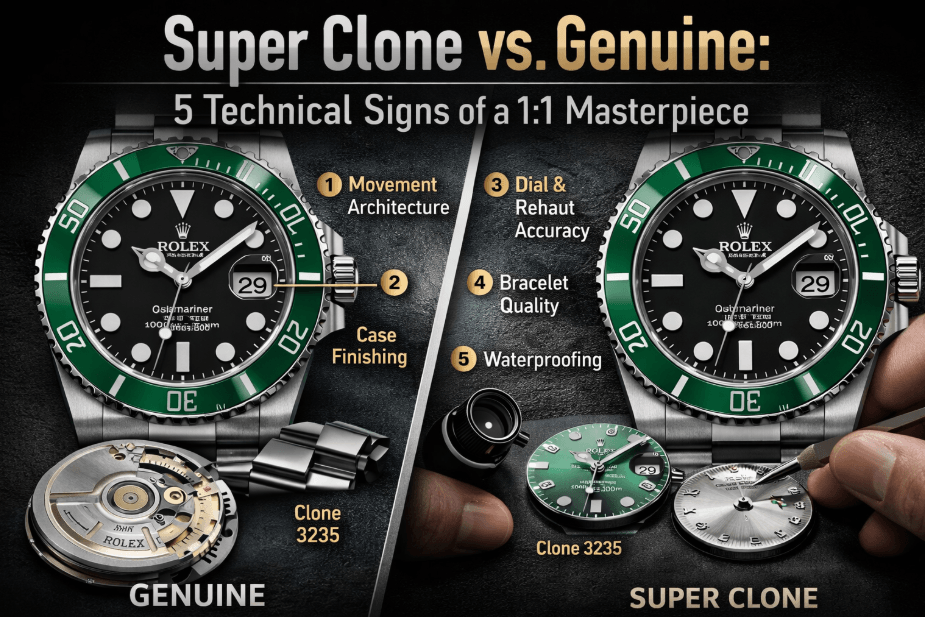
The 5 Technical Signs of a 1:1 Masterpiece
1. Movement Architecture and Amplitude Stability
A true 1:1 superclone maintains stable amplitude under daily wear conditions. This is achieved through efficient gear train design and proper escapement alignment.
Why it matters: stable amplitude ensures consistent timekeeping and reduces long-term wear on internal components.
Real-world impact: the watch keeps accurate time throughout the day, even with varying activity levels.
2. Case Finishing and CNC Precision
High-end factories use advanced CNC machining to produce cases with tight tolerances and clean transitions between brushed and polished surfaces.
Why it matters: genuine watches are defined by their finishing consistency, not just their shape.
Real-world impact: under close inspection, the watch maintains sharp edges, correct lug curvature, and balanced proportions.
3. Dial Printing and Rehaut Engraving Accuracy
Dial text alignment, font thickness, and spacing are critical indicators of quality. Rehaut engraving (the inner bezel ring) must also match genuine depth and positioning.
Why it matters: these are areas where lower-tier replicas often fail.
Real-world impact: even under magnification, the watch appears authentic.
4. Bracelet Construction and Clasp Feel
Bracelet quality is often overlooked but plays a major role in overall perception. High-end builds feature solid links, precise tolerances, and smooth articulation.
Why it matters: the tactile feel of the bracelet is immediately noticeable.
Real-world impact: the watch feels substantial, with a secure and refined clasp mechanism.
5. Waterproofing and Sealing Integrity
Top-tier superclone watches are built with proper gasket systems, screw-down crowns, and sealed casebacks, making them effectively waterproof under normal conditions.
Why it matters: genuine watches are designed for real-world use, not just display.
Real-world impact: the watch can handle daily exposure to water without performance issues.
Who Builds True 1:1 Superclones
VSF remains the benchmark for movement-focused builds. Its VS3235 and VS3135 calibers are engineered for stable amplitude and efficient power delivery, making it ideal for models like Submariner and Datejust.
Clean Factory prioritizes external finishing. Its expertise in bezel construction, dial accuracy, and bracelet feel makes it the preferred choice for visually critical models like GMT Master II and Daytona.
ARF is known for bracelet construction and case finishing, often producing some of the most realistic bracelets in the market. APS specializes in complex movement builds, while 3K focuses on slim-profile designs and integrated bracelet models.
All of these factories are based in China and supply a global market, with strong demand among USA buyers seeking high-end superclone watches for sale.
Model-Specific Performance Differences
In the Submariner, VSF stands out due to its movement stability and strong waterproofing. Clean offers slightly sharper bezel finishing, but VSF delivers better long-term reliability.
For the GMT Master II, Clean leads with accurate ceramic bezel colors and precise dial execution, making it the top choice for collectors focused on aesthetics.
The Daytona benefits from the DD4130 movement, providing authentic chronograph functionality that closely mirrors genuine performance.
In the Datejust, VSF’s VS3235 movement ensures smooth date changes and consistent timekeeping, while ZF offers alternative dial configurations for collectors seeking variety.
Buyer Decision Strategy
Buyers across the USA typically approach the superclone market with three priorities: performance, appearance, and value. The key is understanding which factor matters most for your intended use.
A daily wearer should prioritize movement reliability and waterproofing, while a collector may focus on finishing and visual accuracy. Matching the factory’s strengths to your needs is more important than choosing a “popular” option.
Real-World Scenarios and Practical Insights
A buyer in New York purchasing a Datejust for professional wear needs a watch that maintains accuracy and withstands daily use. VSF’s movement stability makes it the logical choice.
In Los Angeles, where visual presentation often matters more, Clean Factory models are popular due to their refined finishing.
One common mistake among first-time buyers is focusing solely on price. Lower-cost replicas often compromise on movement quality, leading to inconsistent performance over time.
What You’re Really Paying For
The price of a superclone reflects its engineering complexity. Movements like the DD4130 require precise manufacturing and assembly, which increases cost but delivers superior performance.
Material quality also plays a role. 904L steel and high-precision CNC machining result in better durability and finishing, justifying the higher price point.
For buyers evaluating options, understanding these factors is essential. Many rely on resources like the
1:1 Superclone authentication guide
to identify true high-end builds.
Maintenance, Longevity, and Ownership
High-end superclone watches operate on the same mechanical principles as genuine watches, which means proper maintenance is key. Regular servicing ensures lubrication remains effective and components function smoothly.
With proper care, these watches are capable of long-term performance. Key factors include movement maintenance, rotor efficiency, and gasket integrity for waterproofing.
Market Trends and Preferences
The USA is one of the largest markets for superclone watches, with strong demand in cities like New York, Los Angeles, Miami, Chicago, Houston, Dallas, and San Francisco.
Buyers across the USA typically compare factory reputation, movement reliability, and seller credibility before making a purchase. Preferences vary by region, with coastal cities often favoring visually refined models, while others prioritize durability and value.
Why Choose SupercloneWatch
SuperCloneWatch positions itself as a trusted source by focusing on verified factory sourcing and strict quality control. This ensures buyers receive authentic factory builds rather than downgraded alternatives.
For both new and experienced buyers, this level of transparency is critical in a market where quality can vary significantly.
Conclusion
A true 1:1 superclone is defined by more than appearance it’s about mechanical integrity, finishing precision, and real-world performance. By understanding the five technical signs outlined in this guide, buyers can confidently distinguish high-end builds from standard replicas.
For collectors in the USA and beyond, the key is to prioritize performance and reliability over assumptions.